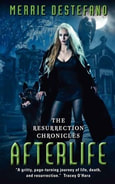
Whoops. I’ve been so busy I forgot to wax poetic about my upcoming novel. I finished the edits recently, now waiting for the copy edit cycle to begin. Not sure everything that will happen after that. I know my editor, Diana Gill, told me, but it’s all still a blur.
But I can tell you the name of the book.
Afterlife.
I love the title. And I’m looking forward to getting the finished cover so I can post that here. I’m sure it’s going to be fantastic. I’ve seen some of the other covers HarperCollins/Eos has done recently, like Tracey O’Hara’s Night’s Cold Kiss and Patrick Lee’s The Breach, and they’re both off-the-chart awesome.
Eeeeek. Okay, just a little girly scream of excitement there. I have to let it out now and then.
Listening to Van Helsing soundtrack and writing about vampires. Feel like I should be in a castle in the Carpathian Mountains, overlooking a rain-drenched landscape. Imagining that forest of staked corpses that lined the River Danube—handiwork of Vlad Dracula. Thinking about Lord Byron and how his twisted romantic liaisons forever changed the way we perceive vampires. And now the writing begins…
I think it’s been quiet around here long enough. Time to start blathering again. I’ve been so busy I don’t even know where to start, so I may as well begin with the latest. I just got an advance copy of a book I’ve been working on: How to Draw Zombies. Artist Mike Butkis and I co-authored the book and I must say, his art is phenomenal.
You can see the cover here. Dark and gruesome and gorgeous. And down below is an interior spread.
And yet another interior spread…
I used to want to be the next Dean Koontz or Stephen King. I struggled for so long to try and fit my shoes into their footprints. Not anymore. Now I want to be the best Merrie Destefano I can be. I want my stories to be as fresh and unique as possible, and I seek to always maintain my own voice.
That said, I know that over time, my voice will evolve, as it should. My stories will get better, the characters richer, the plots more intriguing. I hope to mature in my own skin, with my wrinkles and folds and freckles reminding me of my imperfections. I want to drink in the work of other writers and musicians and artists to refresh myself, like a lioness in the Serengeti, pausing from the hunt just long enough to regain my strength.
I want to always have a novel under my fingers, tangled like skeins of yarn, waiting to be woven into a literary garment of beauty.
Being a writer is the work of a lifetime. There is no “arrival,” no aha moment.
Feet bare and dusty, I want only to continue on the wilderness path my entire life, glimpsing my characters as they peek at me from the forest deep. I want communion with the black and white words that hum like music as they congregate together, first into sentences, then paragraphs, and finally entire novels.
I crave the solitude and mental awareness that comes from creating stories—from building one scene on top of another like totems of glue and feather and bone.
I am a writer. I pray that I may ever be.
Today I’m reviewing Tracey Bateman’s new book, Thirsty. An award-winning author with close to one million books in print, Bateman successfully crosses genres with her latest novel. A good portion of the book focuses on a strong female character—a trait that I think will garner readers who appreciate women’s fiction and suspense. Thirsty also breaks ground as a CBA novel, boasting a centuries-old vampire as one of the main characters, a fact that places it in the category of speculative fiction, as well.
The Story:
Nina Parker wanted it all: husband, kids, house on a quiet street. And she had it, once. But then one day, she gave in to the monster that had been hiding inside her for years—alcohol addiction. After humiliating herself on her ex-husband’s doorstep on Christmas Eve, she finds herself arrested and subsequently ordered to three months of rehab. After that, she’s a new woman. But it’s going to take a lot more than 90 days of sobriety before she can convince her ex, Hunt, or her children. She leaves Texas and moves home to Abbey Hills, Missouri, hoping to build a new life, one that might someday include the family she leaves behind in Dallas. But her hometown isn’t quite what she remembered. There’s something ominous here, stalking and killing animals, murdering people. The fact that Nina’s sister, Jill, is the sheriff should provide some comfort and protection. But it doesn’t. Before long Nina realizes that there are dark forces at work in Abbey Hills. And both she and her teenage daughter, Meg, find themselves tangled in a dangerous power struggle between two supernatural creatures who are addicted to something even more deadly than alcohol: blood.
Strengths:
While this is a supernatural tale that includes vampires in its landscape, the heart of the story revolves around addiction. The main characters, both human and vampire, struggle with forbidden desires and obsession. The characters are well drawn and believable—not an easy task, especially when one of them—Markus Chisom—is hundreds of years old and suffers from the inherited curse of vampirism. Metaphors abound, yet the story never falls prey to allegory or trite symbolism. Bateman tackles the delicate subject matter of alcoholism with an expert hand, showing the reader just enough back story to understand why each character makes the choices they do.
Recommendation:
I enjoyed this book and would highly recommend it to CBA readers who like general fiction, women’s fiction, thrillers, suspense, supernatural fiction, and—the new growing sub-genre of speculative fiction—vampire fiction. CBA is still in the midst of breaking ground in this genre and I hope that we see more soon. I’m looking forward to Bateman’s sequel to Thirsty and I hope that then we’ll get a chance to see more of the unique vampire world she has created.
You can check out the first chapter of the book here.
And in accordance to the new FTC regulations, I’m informing you that I received a copy of Thirsty directly from the publisher, WaterBrook Press, for review purposes. I review only books I have read, and only state my honest opinion of the book.
Tracey Bateman, author of Defiant Hearts, Leave it to Claire, and The Freedom of the Soul, just ventured into new territory with her recent novel, Thirsty. As the latest addition to CBA’s growing collection of vampire lore, Thirsty joins the ranks alongside Eric Wilson’s Jerusalem’s Undead Trilogy and John Olson’s Shade—cutting edge fiction that depicts both the monster and the myth, as well as the spiritual elements below the surface. Bateman’s contribution to this fledgling Christian genre also deals with another monster many of us may recognize, up close and all-too-personal: addiction. Both themes twine together throughout the book, and Bateman has created an interesting tale with believable characters—a feat not easy to achieve when one of your characters also happens to be an immortal beast with a penchant for blood.
Today, we have an interview with the author. A review of Thirsty will be posted on Friday. Meanwhile, I suggest you grab a glass of your favorite beverage and make yourself cozy before you begin to read…well, as cozy as possible when the topic of discussion is the creation of an undead vampire, as lovely and charismatic as Edward Cullen or Stefan Salvatore.
MERRIE: How did you come up with the concept for Thirsty?
TRACEY: The idea to write a vampire novel was presented to me by my editor. But I had to write a proposal and still go through the process of committee and all that. At first I thought along the lines of the same old vampire stories that have been around forever. It felt safe and familiar to me. But as I presented it to my editor, she pushed back and challenged me to think a little differently and it allowed me to open up to this idea of the vampire as a metaphor. Well, what would he be a metaphor for? And then I knew. Alcohol.
MERRIE: It was a great metaphor, by the way. How long did it take you to write this book?
TRACEY: I wrote and rewrote it a few times, so it took a year. But I didn’t write on it all that time. The process of writing, I’m learning (after almost 40 books!) is as much about the mulling over and thinking about characters, period as it is about the writing itself.
MERRIE: The themes of addiction, obsession, and heredity seem intertwined in this story. Which came first when developing this story: the vampire or the addiction/obsession?
TRACEY: Oh, well I sort of answered this already, but the vampire came first. The IDEA of vampire, I didn’t know this one specifically until I added the element of alcohol, then came the idea of generational curses or heredity.
MERRIE: Do you see Markus as a tragic character?
TRACEY: As tragic as any addict. That doesn’t mean pathetic. Let me make that distinction. Anyone in the throes of their addiction is in a tragic place of suffering.
MERRIE: Do you plan to write more speculative fiction?
TRACEY: I’m writing the next book that will take place in Abbey Hills. I very much would like to write more speculative fiction. I honestly never would have been gutsy enough to propose it if I hadn’t been handed the opportunity to try, but now that I have I am determined to write more and get better.
MERRIE: I think there are a lot of speculative fiction readers who would love to see you write more in that genre. What is your favorite vampire story?
TRACEY: Interview With a Vampire. Dracula scares me!! I also love The Lost Boys and Salem’s Lot.
MERRIE: Excellent answer! Lost Boys and Salem’s Lot are two of my all-time favorites, too. How did you come up with the back story/legend of your vampire? Did you base it on pre-existing legends or did you create your own?
TRACEY: A little of both. While it would have been easy to create my own from the ground up, I felt that vampire fans would be disappointed with a vampire that didn’t have familiar elements. I tweaked the lore a bit to suit my addiction storyline. For instance, vampirism is inherited, but chosen. Like any addiction.
MERRIE: I really liked that part of the story. Legends change with each retelling, and I enjoyed your version. Was there a particular scripture that you used as a basis for this story?
TRACEY: Not really. I have several scriptural themes represented but not an actual word for word verse.
MERRIE: Have you ever had anyone close to you struggle with alcoholism?
TRACEY: Yes. Many family members, extended and immediate. I have also struggled with addiction. This story is very close to my heart.
MERRIE: I’m going to talk a bit about alcoholism during my book review on Friday, but for now, suffice to say, it’s a theme close to my heart too. Do you think CBA will be opening up to more vampire stories in the future?
TRACEY: I don’t know. Eric Wilson’s Field of Blood and Haunt of Jackals are out there with one more to come. I have one more to follow Thirsty. If the market supports them, we’ll see more. Like prairie romance and Amish stories. If we can’t win over the Christian audience to accept vampire stories, we won’t be seeing anymore. The bottom line is the bottom line.
MERRIE: Who was your favorite character in this story and why?
TRACEY: Nina. Because she is so messy and so real and wants to do better. Just like me and everyone I know.
MERRIE: What three tips do you have for other writers?
TRACEY:
1. Work hard at loving your family and letting them know they mean more to you than your computer. Especially if your children are too young to rationalize that mommy has to work so they can have a better future. Their future is when is Dora coming on TV. They just want you.
2. Read a lot of really great writers and don’t stick with what is familiar and comfortable.
3. Brand early and stick with it. I didn’t do this and it has hurt my career. One of my friends had two proposals being shopped at once. A suspense and an historical. The publishers chose the suspense and her agent wouldn’t shop the historical because brand was a focus. It has paid off hugely and this author is a best seller. After ten years she is NOW publishing the historical suspense series and I have no doubt it will be huge.
MERRIE: Great advice! What is your writing ritual? [Do you write 1,000 words a day, write for 5 hours every day, etc.]
TRACEY: I wish I had a better ritual. I’m actually in the process of looking for a life coach to help get me better focused. Got any suggestions?
MERRIE: LOL! Well, I wish I had a writing therapist to walk me through the dilemma of ‘Which version of this book is best?’ Maybe there’s someone out there right now who does both. If so, contact us! Do have anything else you would like to add?
TRACEY: Just that writing a vampire novel is a big risk, but probably the best chance I’ve ever taken. I’ve learned more from my current editor than I’ve ever learned in terms of growth as a writer. Also, I knew going in that it could flop as easily as soar and time will tell which is going to happen, but I also knew I was following my heart. I believe totally that God led me to write this and no matter what happens, I won’t regret it. And I don’t say that in a defensive way. More surrendered.
MERRIE: I personally think it was a risk well worth taking and I look forward to the second book in this series. Thank you so much for stopping by and answering all of my questions. Just a quick note for my blog readers, you can both purchase and read an excerpt of Thirsty on Amazon.com. I recommend you take a look at it. It’s a great book!
Trying to remember why I thought it would be a good idea to give up caffeine.
Something to do with the fact that it was eating my stomach lining and giving me an ulcer. Something completely random and unfounded. Meanwhile, two weeks after Black Friday—the day I spent in Urgent Care, giving a doctor access to parts of my body that nobody else has—my stomach seems perfectly happy.
But my energy level has plummeted. I thought I was low-energy before. Apparently I was mistaken.
Now it takes two naps to get me through a “normal” day, and simple things like buying groceries or doing laundry suddenly feel Herculean. I think I deserve a Pulitzer for washing the kitchen floor, a Hugo for vacuuming.
And you best believe, I’m expecting an Eisner for scrubbing that toilet.
“I can’t breathe.”
Now keep writing.
But I just used my last gulp of oxygen. How can I make this pencil work? How can I make my brain work?
Fill out the form. Get in line. You’re just a number, remember.
My knees are buckling. My head is whirling, filling with sparkling lights, voices are echoing around me.
Just write your name. Forget about the rest.
My name. Got it. My address? Can’t remember. Can’t think clearly. Can’t.
Leave it blank. Cause for visit. Tell them. Quick.
I think I’m dying, I think I’ve been poisoned, my throat is closing up—
Write it down. Two words. Dying. Poison. Push the paper in front of that woman with the clipboard. Hurry.
My fingers fall limp, pencils rolls out of my hand, skips across the floor. Paper in hand, I shuffle toward the clipboard, toward the matriarch guarding the doorway. Put the crumpled sheet on the top of her stack. Try to get her to notice me. It’s not working.
Go ahead. Fall down.
I can’t fight it, my legs fold beneath me.
Quiet. Into the night.
Darkness wraps around me, even before I hit the floor. Darkness, but not quiet. I am a raging mayhem, a blistering storm of heat and light, a lava flow of molten flesh. I am a wreck, crashing and burning across the emergency room floor. Even in the not-quiet dark, I know.
It wasn’t poison.
No. Not poison. My sweat on the floor, my blood, my skin. My designer disease, all brand new and . . .
Contagious.
When I was five, did I dream of being a willow that would bend, that would crumple beneath the storm. Did I hope to fling my dreams to the wind. When I was ten, did I think that every face would smile at me, nod and say, yes. That answer is correct. You win the prize, you are my friend, you are my love.
When I was fifteen, did I want every young man to stop and stare, lick his lips and say my name. To cry for me at night and stand in silence in the day.
When I was twenty, did I hope to train my brush to capture light, to conjure color and form. Did I think I could paint a world where I would fit in. When I was twenty-five, were my fingers training to write a story that would make readers weep, cause them to stay awake wondering. What would happen next. What.
When I was thirty, did my weary heart skip a beat, did I stumble when I walked.
Did I sin, did I stop being human.
When I was thirty-five, did I discover love, did I discover God. As if He had been hidden. In the midst of a universe that belonged to Him.
When I was forty, did my arms refuse to obey, did the pictures go away. Did my passion melt and change. When I was forty-five, did the stories come unbidden. Crows that screamed at night. Tell my tale. Tell. When I was fifty, was I hoping then that black would marry white and my near-forgotten dreams might come true. Did I wait. Did I. Wait.
Crows that screamed at night. Did I dream of being a willow that would bend. Beneath the storm, my dreams in the wind. Did I think I could paint a world. Where I could fit in.
Did I wait. Did I. Wait.
Today we have another interview with one of the Marcher Lord Press new authors. Steve Rzasa wrote The Word Reclaimed, part of the MLP fall lineup, which was scheduled for release on October 1, 2009. You can read an excerpt of The Word Reclaimed here, and you can read yet another interview with Steve here.
Now, for the interview…
MERRIE: Could you please give us a brief bio of yourself?
STEVE: I was born and raised in South Jersey – an important fact. I earned a bachelor’s degree in journalism from Boston University’s College of Communications in 2000, and then spent seven years as a reporter and assistant editor at weekly newspapers in Maine. In 2007 my family moved out to my wife Carrie’s home state of Wyoming so I could work as to the editor of a weekly newspaper. Today I work at the local library in Buffalo where we live with our two sons.
MERRIE: How did you first get interested in speculative fiction?
STEVE: I’ve always loved reading, but it wasn’t until high school and college that science-fiction books became my favorites. I watched all the Star Wars movies and as many Star Trek (original series and Next Generation) as I could manage, so you can imagine my excitement when Timothy Zahn came out with the Heir to the Empire trilogy in the early ‘90s.
MERRIE: How long did it take you to write The Word Reclaimed?
STEVE: The Word Reclaimed is actually the first half of a manuscript entitled “Commissioned” which I submitted to Marcher Lord Press at an obscene 180,000 word-length. Thankfully, Jeff Gerke decided he wanted to split the story in two!
The full story took me about six years. That said, it took five years to write the first 60,000 words. Working as a reporter, you don’t find much time for writing fiction – usually when you arrive home, you’re to mentally drained to even want to look at a keyboard.
After leaving the newspaper world, I finished the remaining 120,000 words of the now two-part story in nine months.
MERRIE: Tell us the basic plot of your novel:
STEVE: Baden Haczyk lives in contention with his father aboard the family cargo starship Natalia Zoja. His routine existence is turned on its head when he finds a book in the wreckage of another ship. Suddenly the omnipresent religious police are on his tail, and will stop at nothing to seize the book.
It is set in a future where all printed materials are banned – only electronic media are allowed, and the royal family owns the companies that make all computers, handheld devices, etc.
MERRIE: Who did you enjoy writing about more, your hero or your villain, and why?
STEVE: It was great fun writing about Baden’s grappling with spiritual and family issues. His interactions with his best friend Owen are some of my favorite parts. But they pale in comparison with the satisfaction I gained from writing Detective Chief Inspector Nikolaas Ryke. He’s just so bad! He’s cold, ruthless and all around nasty. It was a very entertaining exercise to write a character in whom one could dump the complete dark side of humanity.
MERRIE: What writer or book has most inspired you and why?
STEVE: I’d have to pick two – Kathy Tyers and Chris Walley. Kathy Tyers wrote the excellent Firebird series that offers a different take on familiar Old Testament prophecies, while Chris Walley’s Lamb Among the Stars series shows a distant future in which sin returns to a galaxy that has largely been at peace. Both are great Christian sci-fi – and it doesn’t hurt that they have cool spaceships!
MERRIE: What’s your favorite speculative fiction book?
STEVE: I have so many favorites that it would be hard to list them all, but if you forced me to pick the ultimate, I’d say Merchanter’s Luck by C.J. Cherryh. Sandor Kreja is an everyman version of Han Solo – the ultimate space loner who makes out as a sort-of hero. He isn’t an action star; he’s not overly handsome; he’s not very inspiring. He’s just a regular guy. Combine him with Cherryh’s meticulously crafted universe of politics, economics and war, and you’ve got a great one.
MERRIE: What’s your favorite speculative fiction movie and why?
STEVE: Star Wars: The Empire Strikes Back, hands down. It bucks the normal movie trend of a neat, tidy happy ending, and it leaves you yearning for more. And you just can’t beat Lando Calrissian – he and Han Solo are my favorite Star Wars characters.
MERRIE: What three pieces of advice would you give to a beginning writer?
STEVE:
1. If you have an idea, even one that seems dumb to you, write it out. Talk to someone about it, and take their feedback seriously. That was the hardest part for me to learn.
2. Find time to write as often as you can. Just don’t do it at the expense of your life!
3. Keep writing, and if you have a passion for your story, doing so will keep it alive. Even when you think “This will never work,” keep at it.
MERRIE: Any closing thoughts?
STEVE: Thanks for giving me time to share with your readers, Merrie. For all you folks looking for some outside-the-box sci-fi and fantasy, check out the Marcher Lord Press line-up for this year and the great titles from the past two releases. More news about The Word Reclaimed is available at www.steverzasa.com
MERRIE: Thanks for visiting with us, Steve! I hope our fellow speculative fiction writers will check out his book at Marcher Lord Press. And check out the special launch bundles available right now.